
10 Things I Learned From Attending My First Writers Conference
As a brown, queer, disabled, & chronically ill writer. // San Francisco Writers Conference 2024 Recap (& why I won't be attending this particular conference again; cw: ableism)

When I first signed up for the San Francisco Writers Conference last year, I thought I would be going into it with the first draft of my novel finished. Unfortunately, due to some unforeseen complications with my chronic health conditions, I was still only halfway finished by the time the conference came around. Although I was nervous about not getting as much out of the conference without a completed manuscript, I’m happy to report that that was not at all the case!
Barring a number of racist microaggressions and a major incident with event accessibility & being treated in an aggressively rude manner by a conference organizer, I came out of the conference feeling energized and ready to get back to writing.
Here are the most important things I learned from the conference, and some things that I wish I’d known beforehand—especially as a disabled writer of color.
Conferences are all about meeting people!
Your conference experience will be best spent trying to make connections with other writers, as well as the agents, editors, and publicists in attendance. I made a surprising number of writer friends at this conference who I’ve since met up with for writing sessions or just to hang out! I highly recommend seeking out other writers who are writing within the same genre, subject matter, etc.
Bring business cards, and get them professionally printed.
I didn’t realize that this was a thing until about 10 minutes before I was about to leave for the conference, so I just quickly designed and printed some on printer paper. All of the other unpublished writers I met had professionally printed cards, and exchanging business cards was one of the primary methods of networking during the conference. I highly recommend using a free business card template, such as the ones on Canva. Here’s what mine looked like in case you’re not sure what to include:
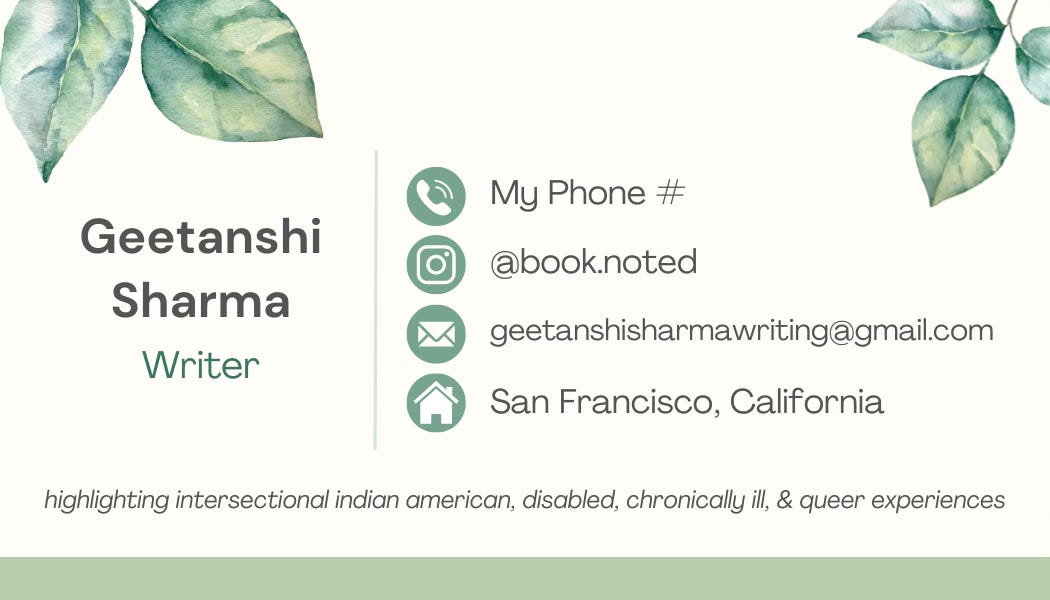
I didn’t see anyone else do this, but I highly recommend including what you write about (I actually had a number of people contact me because of that information)!
Unsurprisingly, most people at writers conferences are white. Somewhat surprisingly (to me, at least), most aren’t afraid to say racist things to you about being an author of color pitching a “diversity book.”
I cannot tell you how many times during this conference I overheard white writers talking about how hard it was for them to get published in the current publishing climate. I had multiple white writers tell me to my face how easy it was going to be for me to be published because I was pitching a “diversity book.” I even had a white editor who I was pitching to cut me off during my pitch to excitedly tell me that there was another Asian girl at the conference writing about disability, and we should pitch our stories together as a boxed set, as the Indian and Chinese versions of the disability experience in America.
How to respond to racist comments about diversity during the conference. For EVERYONE (please speak up!).
In all of the instances mentioned above, I stayed quiet. I was so shocked that I couldn’t think of a response. There was one session during the conference directed towards writers of color, and during it I asked the presenters how they have dealt with comments like this. The author’s response I liked the most involved simply and calmly stating statistics that directly negate such comments. For example: According to the 2023 Publishing Industry Statistics, an overwhelming 73% of authors published in the past year are white, 9% are multiracial, 8% are Asian, 5% are black, 5% are Hispanic/Latino, and 5% are Other. 84% are nondisabled. 67% are heterosexual. 73% of industry staff are white, a number that has significantly DECREASED over recent years.
How to deal with ableism and physical inaccessibility at a conference. This is for my fellow disabled writers, and their allies! (This one’s a bit long, but please read!)
Okay, storytime. On the second day of the conference, the sole elevator to the space where all the pitches and meetings with agents/editors/publicists was out of service. I contacted the operator, conference staff, and hotel staff, but the hotel staff never got back to me and the conference staff had me spend hours that I was planning to spend attending sessions waiting at a table in the lobby so the agents I had meetings with could meet me there. It was too late to make one pitch, and the next agent made annoyed remarks at having to meet me upstairs and gave me less than a fourth of the time I was booked for. I was in tears by this point, having spent hours prepping for these pitches and feeling like there was nothing I could do about the situation.
As a last ditch attempt to be heard, I posted about the situation on instagram and tagged the conference and the hotel.


The next day, the elevator was still broken. When I approached the information table, I received an angry look from the lady at the table, who proceeded to rudely chastise me for posting about the situation on instagram, yelling, “how dare you do such a thing?” She continued lecturing me even after I calmly explained how frustrating this was as an attendee who had paid for the conference and the pitches just like everyone else. She then ordered me to wait at a table while she got the hotel manager, who then escorted me to the staff-only elevator that went to the floor where the pitches were happening. He gave me his number so I could get access to the elevator when I had a pitch. I was able to attend all of my pitches that day, and every session too.
I received dirty looks from the aforementioned organizer for the rest of the conference, and had multiple members of the conference staff come up to me to chat and/or talk about the situation. Not once did I receive an apology from the organizer who yelled at me. Neither did I receive a make-up pitch or consultation for the one I missed. However, a number of other disabled attendees thanked me for speaking up.
What did I learn?
I learned to use my platform to speak up for myself (see #9 on why having a social media platform is important for every author). Before I made a commotion on social media, neither the hotel staff nor the organizers cared enough to figure out how to get me access to the service elevator.
If you’re disabled SPEAK UP FOR YOURSELF. YOUR NEEDS MATTER. Sometimes (actually, often) fear of negative recourse/perception is the only thing that helps you get your needs met. If you’re currently non-disabled, don’t look away from situations like this. You can speak up, too. I can’t tell you how much it helped me to have other conference attendees express their outrage at this situation.
Make sure you research the agents and editors who are going to be at the conference.
I cannot stress this point enough! Know what kinds of books they focus on, and why they might be a good match for you. You’ll have multiple opportunities to connect with agents and editors during the conference, and they expect you to know what they’re all about when you’re pitching (see #7 on how to draft your pitch). This will also help you narrow down who you want to talk to. Most conferences only allow you a limited amount of official pitch sessions, but you can still chat with other agents by going to sessions that they’re a part of or approaching them during social events. Another pro tip is to chat with others during the conference to see how their experience has been pitching to specific agents and editors; I added and removed some people from my list based on others’ positive/negative experiences.